
Murdered a Poet

As you know, ICE has murdered again, this time it was mother and poet Renee Good.
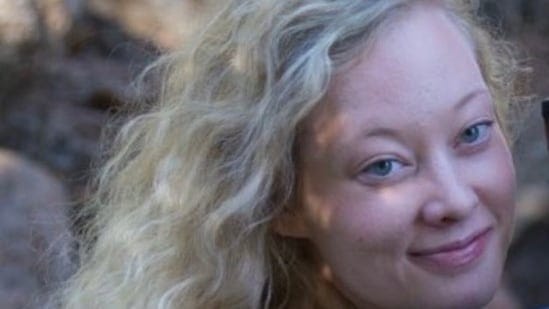
There have been, by and large, two reactions to her death:
1) it was a totally unjustified murder by agent Jonathan Ross who has been given permission to kill by an agency whose directive is to terrorize various nonwhite ethnic communities and the people who defend them.
OR
2) he is a delicate man who has been hurt mentally and physically by years of pressure in various police and military positions, and the delicate man is totally justified in killing Good because she drove right at him, she hit him with her van, he had to go to the hospital because of being hit by the van and he was just doing his job, which, among other duties, is to murder and if you watch the video with your eyes and happen to be a Republican, then you will see that he had no other option.
There are some squabblings about the details but those are generally the reactions I am seeing. As are others.
It might be hard to tell, but I am in Camp Unjustified. Besides the documented strategy of border agents stepping in front of vehicles to justify shooting at them, here are some of the main reasons I believe it was not necessary to murder Good:
Ross’s life was never in danger.
He was not hit by the van.
He and the rest of ICE should not have been there at all.
ICE should be abolished.
I don’t know her personally, but she was good enough to put herself between a poorly-trained militarized gang of well-funded a-holes and her neighbors. So I and everyone will have to keep saying that ICE murdered Good/good.
I think it’s important to be critical of the response to this killing and make sure, say, we do not forget all the other people ICE has murdered in the last year (in custody and in public). That we do not get so myopic that we aren’t able to draw connections between a country’s government that can call this woman a domestic terrorist and that same government that funds and fuels the genocide of Palestinians. Let us keep adjusting the proportions of our outrage so that we spend our precious life force prioritizing who deserves the most ire (American fascism) and who deserves less (the well-meaning but misaligned responses against said fascism).
In that spirit, I want to talk a little about Good being a poet. I don’t watch cable news and my view of the world is filtered through IRL connections like my neighbors and friends as well as my NRL connections like social media friends and who the algorithm thinks I am. So, like many of us, my perspective on reality is skewed. And from that skewed reality, it feels a bit like—to some—Good being a poet makes her life somehow more valuable or her death somehow more tragic. Which no one would admit to if asked directly. Maybe I am reading into it.
On the same day that Good was murdered, Chicago announced its new poet laureate, Mayda del Valle. She’s a great choice for the role and I can’t wait to see what she does with it over her two-year term. I am certain that she will help show new audiences why and how poetry matters, including and especially in times as these. She was appointed by our mayor, Brandon Johnson, who has vociferously opposed ICE’s terror in our city, as well.
Poetry is often obsessed with and searching for justice in politics and society. Less commonly does politics turn to poetry for anything. In one day though, America murdered a poet for living her politics and Chicago lifted up a poet for, in part, the same.
I often think about when Adrienne Rich turned down a National Medal of the Arts from the Clinton White House. Here is her award rejection letter:
July 3, 1997
Jane Alexander The National Endowment for the Arts 1100 Pennsylvania Avenue Washington, DC 20506
Dear Jane Alexander,
I just spoke with a young man from your office, who informed me that I had been chosen to be one of twelve recipients of the National Medal for the Arts at a ceremony at the White House in the fall. I told him at once that I could not accept such an award from President Clinton or this White House because the very meaning of art, as I understand it, is incompatible with the cynical politics of this administration. I want to clarify to you what I meant by my refusal.
Anyone familiar with my work from the early Sixties on knows that I believe in art’s social presence—as breaker of official silences, as voice for those whose voices are disregarded, and as a human birthright.
In my lifetime I have seen the space for the arts opened by movements for social justice, the power of art to break despair. Over the past two decades I have witnessed the increasingly brutal impact of racial and economic injustice in our country.
There is no simple formula for the relationship of art to justice. But I do know that art — in my own case the art of poetry — means nothing if it simply decorates the dinner table of power which holds it hostage. The radical disparities of wealth and power in America are widening at a devastating rate. A President cannot meaningfully honor certain token artists while the people at large are so dishonored.
I know you have been engaged in a serious and disheartening struggle to save government funding for the arts, against those whose fear and suspicion of art is nakedly repressive. In the end, I don’t think we can separate art from overall human dignity and hope. My concern for my country is inextricable from my concerns as an artist. I could not participate in a ritual which would feel so hypocritical to me.
Sincerely, Adrienne Rich
cc: President Clinton
Art “means nothing if it simply decorates the dinner table of power which holds it hostage” and “cc: President Clinton” are my favorite parts of that letter.
I would love to have Rich talking about this particular moment today to help recontextualize and shake our priorities loose. There is a straight line from the “cynical politics” of the Clinton administration to the bald power hoarding of the Trump administrations. I know that del Valle is uninterested in table dressing for the elite and more into “the power of art to break despair.” It appears that Renee Good defied despair with a courage that ended up costing her life. Because Jonathan Ross, et al are committed to the act of administering despair as the quack medicine of empire.
I was actually one of the five finalists for the Chicago poet laureate position this time around. Which was a great honor (though I am very glad it is Mayda and not me (for many reasons), but in my interview they asked me what the focus of my term would be to help bring poetry to all Chicagoans. I said something like it would be to help all Chicagoans (re)introduce themselves to the poet they already are. Because I believe everyone is a poet, in the same way everyone is an artist. We can (and should!) all delight in the magic and music that combining words can create in ourselves and others.
Which means that, to me, the dozens of people ICE has murdered are poets as well, and their silenced voices makes us all poorer.
Alternately, that also means every ICE agent is a poet, that art is their “human birthright,” and the degree to which they realize it might actually matter. Wallace Shawn (playwright, essayist and anti-land war in Asia advocate) once wrote, “If an afternoon of reading poetry has given me a feeling of profound well-being, I don't then need to go out into the street and seek satisfaction by strangling prostitutes... Beauty really is more enjoyable than power." That feels true, but makes one ask “whose beauty?” and “which power?” Hitler was a painter, as well as George W. Bush:
https://youtu.be/c0mS5I-j_Gc?si=xfsy-xhl7E7V93UE
I got to have a look at some of John Wayne Gacy’s original paintings. One was a mountain lake. Another was a sailboat. There’s an enormous body count for appreciators of beauty. Their art decorates a dinner table that exclusively serves Soylent Green.
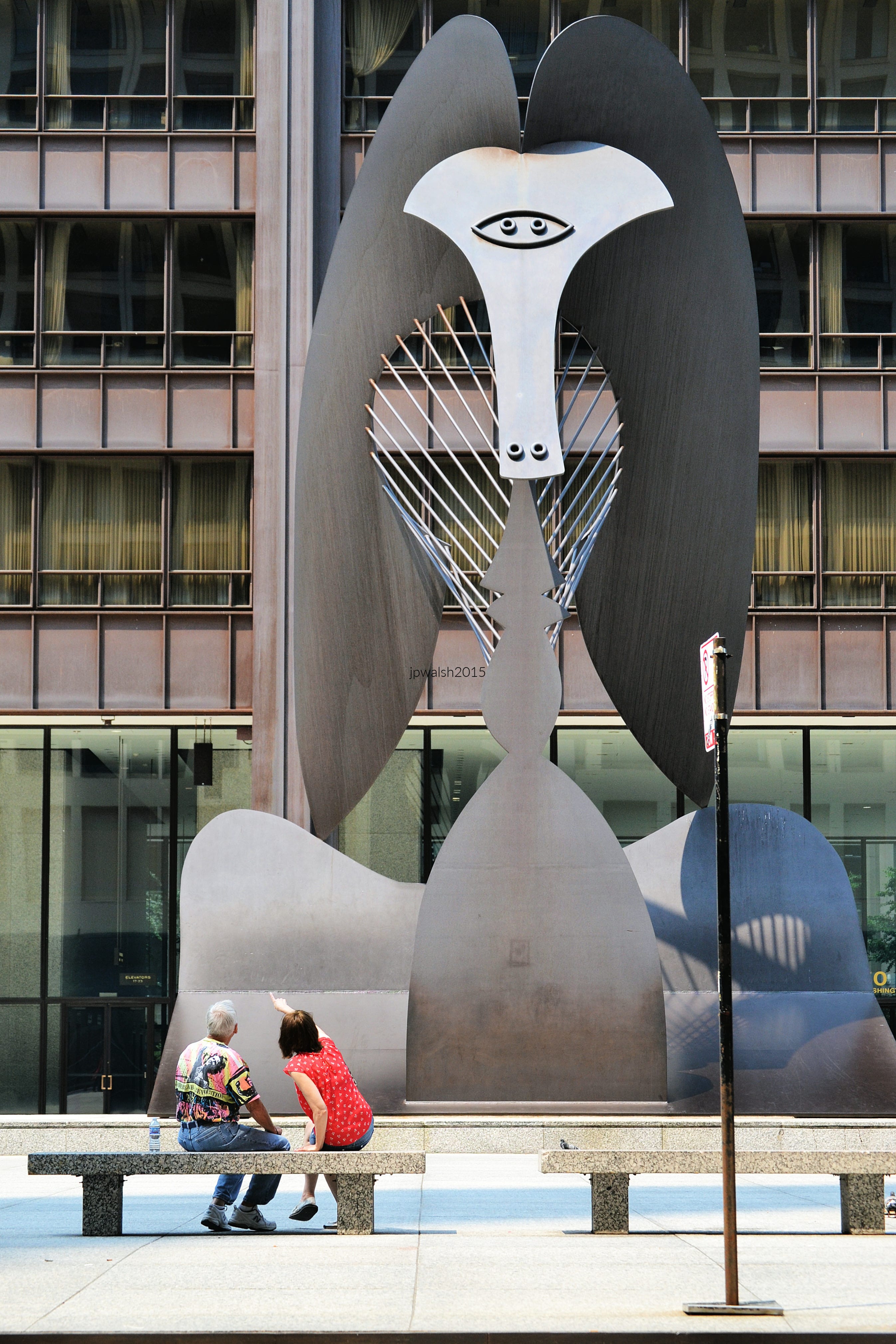
So it’s not enough to value beauty, and anyway, art isn’t only about rendering what is pretty. Art interrogates and challenges. It is a “breaker of official silences, [a] voice for those whose voices are disregarded…” Gwendolyn Brooks (who is the unofficial Chicago poet laureate of eternity) was asked to write a poem about the famous Picasso sculpture here (that is clearly an aardvark), and when asked about her poem she said:
Well, in the 'Chicago Picasso,' first of all, I was asked to write a poem by the mayor of Chicago about that statue, and I hadn't seen it. I had only seen pictures of it, and the pictures looked very foolish, with those two little eyes and the long nose. And I don't know a great deal about art myself; I haven't studied it. So I really didn't feel qualified to discuss what Picasso was doing or had intended to do. So I decided to handle the situation from the standpoint of how most of us who are not art fanciers or well educated in things artistic respond to just the word art, that it's not a huggable thing, as I said here: 'Does man love Art? Man visits Art.' ... And we visit it, we pay special, nice, precise little calls on it. But those of us who have not grown up with or to it perhaps squirm a little in its presence. We feel that something is required of us that perhaps we aren't altogether able to give. And it's just a way of saying, 'Art hurts.' Art is not an old shoe; it's something that you have to work in the presence of. It urges voyages. You just can't stay in your comfortable old grooves. You have to extend yourself. And it's easier to stay at home and drink beer.
What art is ICE capable of? What poetry does Jonathan Ross write in a different universe? Maybe one day, in that universe, instead of staying home and drinking beer, he takes a poetry workshop with Renee Good. And he is self-conscious sharing because she is more confident and experienced. Maybe he writes a poem that is hurtful and she has a visceral reaction to it. Maybe he says, “This is why I didn’t want to share!” Maybe she says, “That’s fine, dude. I’m not mad at you,” and maybe she quotes Brooks, “With poetry, we can ‘feel that something is required of us that perhaps we aren't altogether able to give.’’” And in the safety of the workshop setting they can deescalate the tension and learn from each other about the systems that put guns in front of neighbors and vans in front of guns. Maybe he comes back to the next workshop and eventually discovers that poetry isn’t the poem, that art isn’t the painting, that when we speak the words we make to each other that we need to be able to breathe the same air, that that air is the fuel of our breath, that that air is the sound wave boat to our ears, that we need to share our air with our air and only then do we become, finally, art.
Of course this fantasy is indulgent and almost impossible to believe—in this or any universe. But it’s that “almost” I get hung up on. Nobody should hold their breath that the fascists in power and their foot soldiers are going to suddenly acknowledge the deep joy available to anyone who sees the value in sharing/community/kindness, etc... We have to borrow bravery from the air Renee has left behind and protect our neighbors.
But as Mister Rogers sings:
It’s great to be able to stop
When you’ve planned a thing that’s wrong,
And be able to do something else instead
And think this song:
I can stop when I want to.
Can stop when I wish.
I can stop, stop, stop any time.
And what a good feeling to feel like this.
And know that the feeling is really mine.
There is always a point when someone, no matter how much harm they have caused, can stop and choose clean instead of dirty pain. To choose to build instead of destroy. To choose a life of Good.
Thank you for this, Robbie. Oof. These are heavy days. Your art helps lift it.